They deserve more credit than we give them
In January, Terra Industries, a Nigerian defence startup and drone maker, closed an $11.75 million round led by 8VC, with Lux Capital, Valor Equity Partners, SV Angel, and Nova Global also participating. On the face of it, no Nigerian VC was on the cap table, and Nigeria’s next frontier technology was being funded by American defence-tech money.
Predictably, this reignited the favourite pastime of Nigerian tech Twitter: dunking on local VCs. Why didn’t they back this? Where were they? Do they even have vision?
I’ve done this before. I have written at length — here and here — about the limitations of the VC model in Nigeria, the narrow thesis most funds operate on, the lack of exits, and the valuation games that have burned capital. I stand by all of that.
But the current discourse lacks context. It confuses fair criticism with cheap shots and it compares Nigerian VCs to their American counterparts without asking the most basic question: are they even playing the same game? Spoiler: They are not.
A Category That Doesn’t Exist
Terra’s $34 million raise from American defence-tech investors is impressive. It is also a product of an ecosystem that has no Nigerian equivalent.
In the US, companies like Anduril and Palantir operate within a defence-tech market where investors with the right security clearance can deploy billions into companies selling to the Pentagon, NATO allies, and critical infrastructure operators with multi-year government contracts. American defence-tech startups raised $31 billion in 2024 alone. There is an entire government procurement pipeline, anchored by the Department of Defence’s innovation budget, that creates the demand signals VCs can underwrite.
Nigeria has none of this. No structured procurement pipeline funnelling contracts to startups. No defence-tech ecosystem where a VC can back a drone company knowing the military will be a reliable customer. The Nigerian military itself publicly admits it cannot produce its own equipment due to inadequate R&D investment.
So when critics ask why Nigerian VCs didn’t back Terra, they’re asking why funds operating in Lagos didn’t behave like funds operating in a $31 billion category that doesn’t exist in their market. Terra’s original $800K round included African investors: Alpha Gaps, Tofino Capital, Kaleo Ventures, Velocity Digital, and DFS Lab. The $34 million that followed came from a type of capital that Nigerian venture simply does not have access to.
The Capital They Actually Have
Unlike most of the developed world, the typical Nigerian LP is not a pension fund, a university endowment, or a sovereign wealth fund writing nine-figure cheques from a diversified portfolio. The typical Nigerian LP is someone between 45 and 60, with kids settled abroad, who has done well enough in their career to have some disposable capital. Instead of buying another plot of land in Ikoyi or Lekki, they put between $10K and $200K — money that is effectively retirement savings, school fees, or wedding funds — into a venture fund.
They are making a concentrated, high-risk bet on the Nigerian tech ecosystem with money they may actually need.
The domestic capital pool is shallow. The same high-net-worth individuals and family offices that venture funds are courting are also being chased by financial advisors, asset managers, private bankers, real estate developers, and everyone else competing for a thin slice of deployable Nigerian capital. Venture, with its 10-year lockups, no distributions, and binary outcomes, is the hardest sell in the room.
Where institutional money flows in, it largely comes from Development Finance Institutions. DFI capital provides scale that local LPs cannot, but it is not free money. It comes with mandates: financial inclusion, job creation, SME support, gender-lens investing, climate considerations, and measurable development outcomes.
Nigerian VCs who depend on DFI capital cannot freely chase every category. They cannot pile into crypto infrastructure like a US fund. They cannot back a defence startup even if they wanted to. They cannot deploy into categories that don’t fit the impact thesis their LPs signed up for.
Even the best-capitalised funds tell this story. When Ventures Platform raised $64 million for its second fund, its LP base included IFC, British International Investment, Proparco, Standard Bank, AfricaGrow, and European family offices. Most Nigerian funds are working with much thinner bases, where the money behind the fund has a face, a family, and a retirement plan attached to it.
What They Built With It
Here is what Nigerian VCs actually did with these constraints.
Before Tiger Global wrote a $250 million cheque for Flutterwave’s Series D, someone had to believe that building payment infrastructure in Nigeria was a venture-backable idea. Local VCs and early-stage funds wrote the first cheques into Flutterwave and Paystack without a $10 billion fund behind them. They had conviction built on understanding the market. Paystack was acquired by Stripe. Flutterwave built infrastructure powering e-commerce across 33+ African countries. The payment rails they funded in the 2010s are now the backbone of Nigeria’s digital economy.
Before Andela raised $381 million from Al Gore, Mark Zuckerberg, and SoftBank, some local investors believed Nigerian software developers were world-class and that someone could build a business proving it.
Before Moniepoint raised over $200 million from IFC, Google, and Visa, local investors like Oui Capital, Quantum Capital, and Verod Capital backed a company that now processes $250 billion annually in payments, employs over 4,000 people, and supports millions of merchants, bringing financial services to parts of Nigeria that banks actively ignored.
These sub-$10 million vehicles collectively seeded tens of thousands of direct jobs and the foundations of a digital economy that would have seemed implausible a decade ago.
The Risks Nobody Else Takes
Even when conviction pays off, the return math is structurally capped. Oui Capital’s early bet on Moniepoint — one of the best seed-stage outcomes in African VC history — returned roughly 53x after dilution. That is exceptional by any standard, local or global.
But as Samora Kariuki of Frontier Fintech points out, Africa’s single best fintech outcome, a company processing over $250 billion annually with $600 million+ in revenue, produces a diluted seed return that reflects smaller exit valuations, longer paths to exit, and entry prices that haven’t always accounted for either reality.
Nigerian VCs know this math. They deploy anyway.
They have also backed moonshots that didn’t work. 54Gene raised $45 million to build an African genomics company, backed by local names like Future Africa, Ingressive Capital, and Endeavour Catalyst. Before it shut down, its valuation was slashed from $170 million to $50 million. But the conviction to back African genomics research in a market where less than 3% of global genetic material used in pharmaceutical research comes from Africa, was real.
And they have stomached risks that no Silicon Valley investor has to think about. Founders shutting down businesses after allegedly lavishing investor funds abroad; portfolio companies ending up in EFCC headlines because fraudulent third parties processed money through their platforms; companies failing not because of bad unit economics, but because of wonky policies like okada bans, Naira devaluations, CBN policy reversals, and an unpredictable regulatory landscape.
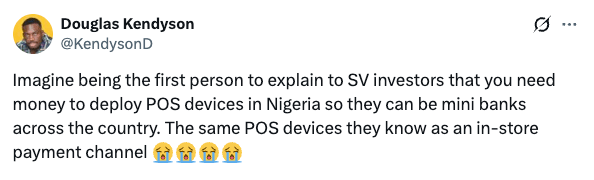
The mobility and logistics bets alone tell this story. Chowdeck, Gokada, MAX, Kobo360, MVX, Treepz, Shuttlers, Cars45, Autochek…Nigerian VCs funded wave after wave. They watched predecessors die and backed the next one. They saw Lagos ban okadas and kept deploying into adjacent plays. When the same thing happens in Silicon Valley, we call it iteration. When it happens in Nigeria, we call it bad judgment.

Thanks to the team at TechCabal for their documentation of this – H/T Damilare Dosunmu and Ngozi Chukwu.
I am not arguing that Nigerian VCs are beyond criticism. They are not.
There are real governance gaps in the ecosystem. Reporting to LPs is inconsistent across funds. Some deal terms are more extractive than they should be. There is genuine herd behaviour, although I would argue that doubling down on fintech, the one sector where Nigeria has proven global competitiveness, is conviction more than it is herd mentality.
Narrative clustering in VC is what Warren Buffett calls institutional imperative: when LPs allocate, GPs raise, and deal flow is sourced, everyone needs to be telling roughly the same story. That is how venture capital works everywhere. The difference is that Nigerian VCs had fewer viable narratives to choose from, and the one they chose actually produced real companies.
What is more urgent is the need for realistic exit planning. Building for local M&A, preaching sustainability, developing secondary markets — these matter more than fantasising about IPOs or foreign acquisitions that may never come. The ecosystem needs more transparency, more discipline, and more honest conversations between GPs and LPs about what venture returns in Nigeria actually look like.
But these are criticisms of execution, not of conviction. And they are a different conversation from the one that erupts every time an American fund backs a Nigerian company that local VCs didn’t.
The Real Gap
The Terra episode did reveal something important, but it wasn’t that Nigerian VCs lack vision. It revealed the categories that remain inaccessible to different pools of capital.
One of the local investors in Terra was Resilience 17, a fund owned by Flutterwave CEO GB Agboola. That is a founder who built a $3 billion company, generated personal wealth, and is now recycling it into the next generation of Nigerian companies. In Silicon Valley, the wealth created by early employees at Stripe, Facebook, and Google seeded thousands of angel investors and fund managers. Nigeria doesn’t yet have enough of this founder-to-funder pipeline.
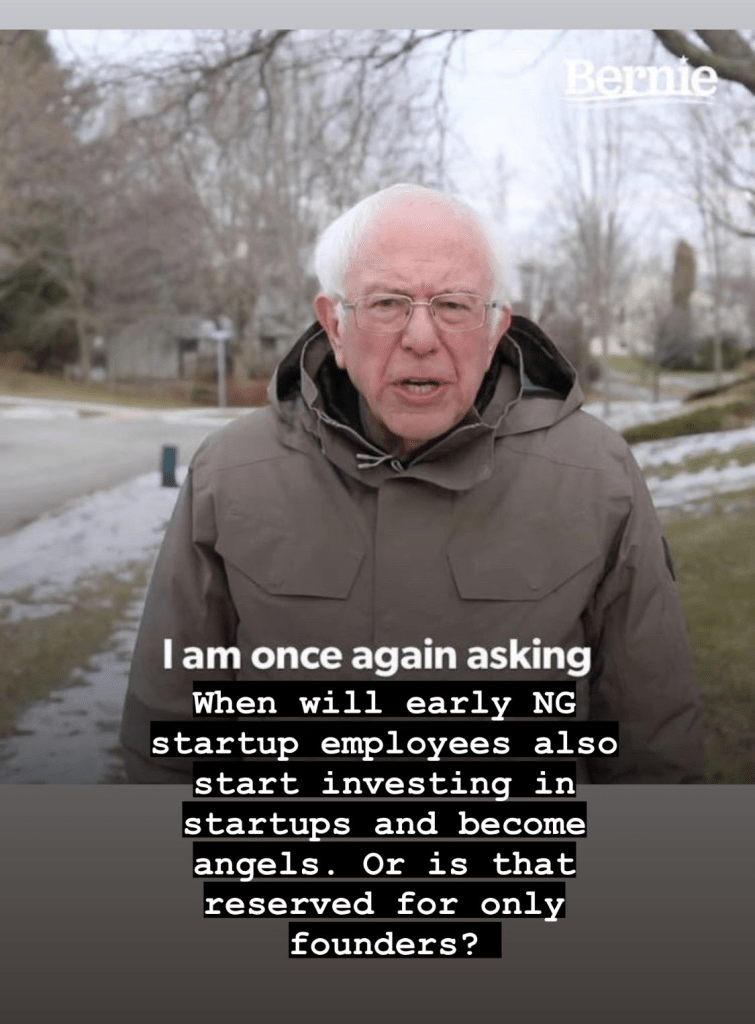
Terra Industries is a genuinely exciting company for Nigeria in 2026, the same way Flutterwave and Paystack were in 2016. The fact that American defence-tech VCs funded them is great for Terra and great for Nigeria. The fact that founders are now recycling wealth into the next generation is even better.
So the next time you want to dunk on Nigerian VCs — don’t worry, I will probably be the one doing it.
But before you do, ask yourself: would you have let your 50-year-old mum or dad invest ₦100 million in Flutterwave or Paystack back in 2016, when Interswitch already existed? Or in TeamApt, when Bluechip, Telnet, and Chams already existed?
Somebody’s parent did. And that bet built the ecosystem you’re tweeting from.
In Defence of Nigerian VCs
They deserve more credit than we give them
In January, Terra Industries (formerly Terrahaptix), a Nigerian defence startup and drone maker, closed an $11.75 million round led by 8VC (the fund co-founded by Palantir’s Joe Lonsdale), Lux Capital, Valor Equity Partners, SV Angel, Nova Global also participated in the round. On the face of it, it seemed no Nigerian VC was on the cap table, and Nigeria’s Next Frontier technology was being funded by a “Palantir co-founder, and his American friends”[sic]
This led to a deluge of tweets, conspiracy theories, articles, and opinion posts about Nigerian/African VCs, and how we are handing over Defence secrets to America for control.
Not trying to burst a bubble in that narrative, but this company raised about $800k from local funds, notably Alpha Gaps, Tofino Capital, Kaleo Ventures, Velocity Digital, and DFS Lab, and this week they confirmed an extension round, which also welcomed Resilience 17 (an investment outfit of Flutterwave CEO Olugbenga “GB” Agboola) onto its cap table.
So we have a Nigerian company dubbing itself the “Anduril of Africa” who has raised roughly $34 million at a valuation north of $100 million, building out drones, sentry towers, and autonomous ground vehicles in Abuja, with $50 million+ in defence contracts secured and a Saudi manufacturing deal to boot, yet they were notably missing a big name Nigerian VC on its cap table – until another founder came along.
Feel free to call this part 4 of our long-running love affair with VCs. You can read parts 1, 2, and 3 here.
So Where are the Nigerian VCs?
Before you dunk again, read this
The Terra raise has predictably reignited the favourite pastime of Nigerian tech Twitter: dunking on local VCs. Why didn’t they back this? Where were they? Do they even have vision?
I’ve done this before. I have written at length — here and here — about the limitations of the VC model in Nigeria, the narrow thesis most funds operate on, the lack of exits, and the valuation games that have burned capital. I stand by all of that.
But today, I want to do something different. I want to defend them. Not because they’re perfect, nor are the criticisms wrong – but the current discourse lacks a context that separates fair criticism from cheap shots and narrow commentary.
Terra’s Story
Terra’s $34 million raise from American defence-tech investors pales in comparison to the $31 billion their American counterparts raised in 2024. Companies like Anduril, Velo3D, and Palantir have created an entire ecosystem where investors (with the right security clearance) can deploy billions into companies that sell to the Pentagon, NATO allies, and critical infrastructure operators with multi-year government contracts.
Unfortunately, Nigerian VCs cannot yet play in this category at scale. Not because they lack vision, as their critics would love to theorise, but because the category does not exist for them.
I watched the 2016 movie “War Dogs” recently, and the one clear contrast from watching it, is how there is no Nigerian government procurement pipeline funnelling contracts to startups, nor is there a Nigerian defence-tech ecosystem where a VC can back a drone company knowing the military will be a reliable customer.
There is no equivalent of the US Department of Defence’s innovation budget creating demand signals that VCs can underwrite.
So when the Nigerian military itself publicly admits it cannot produce its own equipment due to inadequate R&D investment, what exactly are we expecting Nigerian VCs to fund?
Terra’s original $800K round did include African investors who set the stage for the $34 million backing from a type of capital that doesn’t exist in Nigeria’s venture ecosystem — the kind that backs a category that Nigeria’s economy doesn’t yet support at an institutional scale.
So Who is a Nigerian LP
Unlike most of the developed world, the typical Nigerian LP (capital provider to a VC firm) is not a pension fund, a university endowment or a sovereign wealth fund writing $xxx million cheques from a diversified portfolio.
The typical Nigerian LP is someone between 45 and 60, with kids settled abroad. They’ve done well enough in their careers to have some disposable capital. And instead of buying another plot of land in Ikoyi, Lekki or Abuja like their mates, they put amounts ranging from $10K to $200K of what is effectively their retirement savings, children’s school fees or wedding funds, into a venture fund.
They are making a concentrated, high-risk bet on the Nigerian tech ecosystem with money they may actually need. And more often than not, that personal conviction comes with a real downside.
Constraints
World over, the savings rate is a leading indicator of capital and investment capacity, and with the domestic capital pool in Nigeria being structurally shallow, there simply isn’t enough money sitting around waiting to be deployed into high-risk, illiquid venture bets. VCs aren’t the only ones competing for the little that exists. The same HNIs, family offices, and near-retirement professionals that venture funds are courting are also being chased by concierge financial advisors, asset managers, private bankers, insurance providers, real estate developers, and “soft life/hedonistic connoisseurs.”
Everyone is fighting for the same thin slice of deployable Nigerian capital, and venture — with its 10-year lockups, no distributions, and binary outcomes — is the hardest sell in the room. This is why micro-investing platforms, crowdfunding, and investment collectives have become a thing for the emergent middle class. When the formal capital markets can’t deliver enough venture-scale cheques, the ecosystem improvises. Founders are becoming VCs and launching collectives. Angels are pooling money into syndicates. The informal capital stack is filling gaps that institutional capital hasn’t reached.
GB’s investment in Terra is actually the best illustration of what the ecosystem needs and what it lacks. Here’s a founder who built Flutterwave into a $3 billion company, generated personal wealth from that outcome, and is now recycling it into the next generation of Nigerian companies — including categories like defence-tech that institutional Nigerian VCs structurally cannot touch.
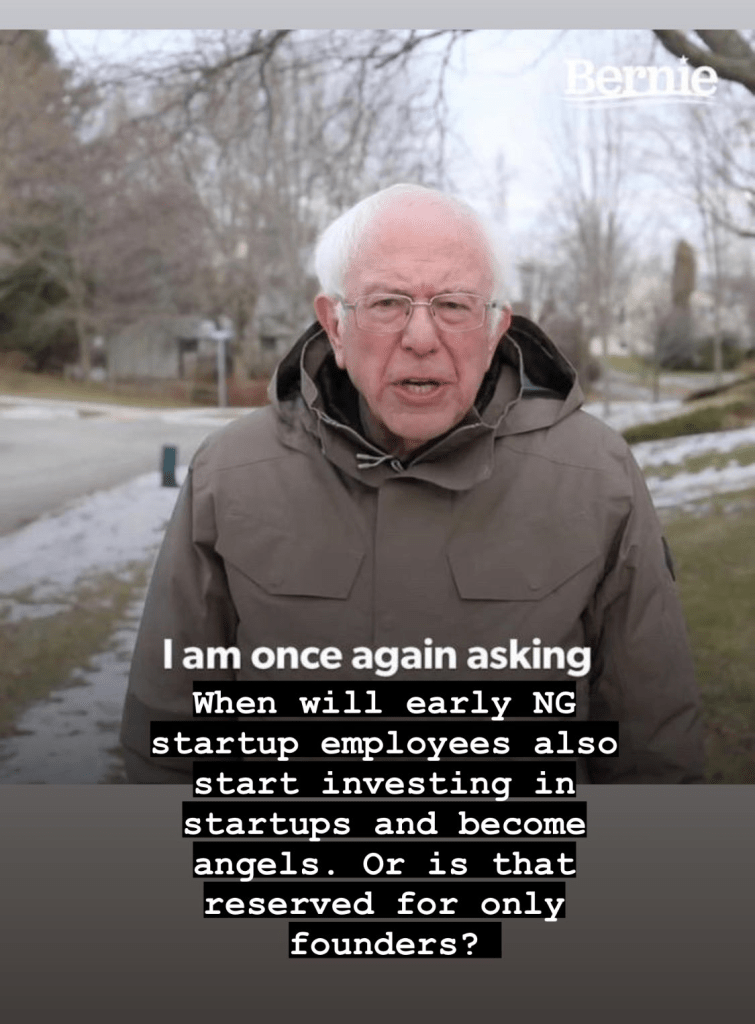
The problem is there aren’t enough GBs. In Silicon Valley, the wealth created by early Stripe, Netscape, Facebook, and Google employees seeded thousands of angel investors and fund managers.
The role of DFI Money (and its strings)
A significant portion of the institutional capital flowing into Nigerian and African VC funds comes from Development Finance Institutions. This is a good thing as it provides scale that local LPs alone cannot deliver.
Unlike individuals, DFI capital is not free money. It comes with mandates, restrictions, and impact requirements that limit what fund managers can invest in. DFIs typically want to see financial inclusion, job creation, SME support, gender lens investing, climate considerations, and measurable development outcomes. This is understandable — they exist to catalyse development, not to maximise returns at any cost.
Even the best-capitalised funds tell this story. When Ventures Platform raised $64 million for its second fund, look at who the LPs were: IFC, British International Investment, Proparco, Standard Bank, AfricaGrow, European family offices, and — for the first time ever — the Nigerian government through iDICE. But many Nigerian funds are not Ventures Platform. Many are working with much thinner LP bases, where the money behind the fund has a face, a family, and a retirement plan attached to it.
But the effect is that Nigerian VCs who depend on DFI capital cannot freely chase every category. They can’t pile into crypto infrastructure with the same abandon as a US fund. They can’t back a defence startup even if they wanted to. They can’t deploy into categories that don’t fit the impact thesis their LPs signed up for.
So you have funds operating in this economy with near-zero secondary markets for liquidity and an exit environment that’s still maturing, while being constrained by LP bases and DFI mandates that further limit sector exposure, yet they still deployed.
What they backed
Here’s what Nigerian VCs actually did with their limited capital, in a market where the odds, liquidity, and exit infrastructure were all stacked against them.
Fintech
Before B Capital, Tiger Global and the other big names wrote a $250 million cheque for Flutterwave’s Series D, someone had to believe that building payment infrastructure in Nigeria was a venture-backable idea. The local VCs and early-stage funds that wrote the first cheques into Flutterwave, Paystack, and others didn’t have Tiger Global’s $10 billion fund.
They had conviction built on understanding the market and being willing to risk capital in it. Paystack was acquired by Stripe. Flutterwave built infrastructure that powers e-commerce across 33+ African countries. The payment rails that VCs funded in the 2010s are now the backbone of Nigeria’s digital economy.
Talent
Andela raised $381 million in total from Al Gore, Mark Zuckerberg, SoftBank, Google, and others, but before all of that, there were local investors and smaller funds who believed that Nigerian software developers were world-class and that someone could build a business proving it.
Business Banking
Moniepoint has now raised over $200 million, notably from the IFC, Google, Visa, and others. Before them, local investors like Oui Capital, Jim Ovia’s Quantum Capital, and Verod Capital backed the company that now processes $250 billion annually in payments, employs over 4,000 people, and supports millions of merchants — bringing financial services to parts of Nigeria that banks actively ignored. It started with people who believed an offline-first business banking play could work when everyone else was chasing digital-first consumers.
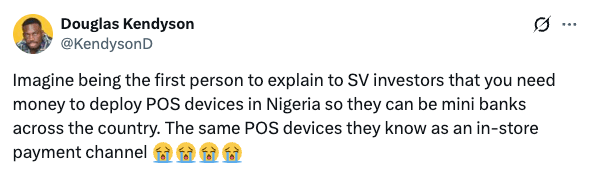
The Moniepoint ecosystem of merchants, agents, and employees represents more direct economic impact per dollar deployed than many companies ten times its funding size.
Andela and Hotelsng trained thousands of engineers, product managers, designers, and operators who are now building the next wave of companies, seeding talent across the world.
These sub-$10 million vehicles have collectively seeded the creation of tens of thousands of direct jobs and a potential trillion-dollar digital economy in Nigeria beyond Olusegun Obasanjo and Ernest Ndukwe’s wildest dreams.
Conviction
Even when the conviction pays off, the return math is structurally capped.
Oui Capital’s early bet on Moniepoint — one of the best seed-stage outcomes in African VC history — returned roughly 53x after dilution. That is exceptional by any local standard. Sequoia made 180x on Google. Benchmark made 670x on Uber. Accel made 800x on Facebook.
Africa’s single best fintech outcome, a company processing over $250 billion annually with $600 million+ in revenue, produces a diluted seed return that is a fraction of what Silicon Valley’s best outcomes deliver. Not because the company is worse. – Samora Kariuki of Frontier Fintech
Despite the lower potential exit valuations here, the path to exit is longer, and the entry prices haven’t always reflected either reality.
Nigerian VCs know this math, yet deploy anyway because that’s their job.
School Fees and Learning Moments
They have even backed the moonshots that didn’t work. Notably, 54Gene raised $45 million to build an African genomics company backed by local names like Future Africa, Ingressive Capital, and Endeavour Catalyst. Before they shutdown, its valuation was slashed from $170 million to $50 million.
But the conviction to back African genomics research, in a market where less than 3% of global genetic material used in pharmaceutical research comes from Africa, was real.
They have also stomached the uniquely Nigerian risks that no Silicon Valley investor has to think about — founders shutting down a business with a blog post after allegedly lavishing investor funds in Dubai and Ghana – check.
Waking up to see a founder you backed being declared wanted by the EFCC on Instagram because fraudulent third parties process money via their platform – check.
These are not risks Sequoia’s LPs lose sleep over.
In this operating environment, companies don’t just fail because of bad unit economics or poor product-market fit.
They fail — or nearly fail — because of okada bans, vague policy interpretations, Naira devaluations, CBN policy reversals, and a regulatory landscape that can turn your portfolio company into a headline overnight.
Conviction also looks like the mobility and logistics bets. Chowdeck, Gokada, MAX, ORide, Kobo360, Lori Systems, MVX, Kwik, Treepz, Shuttlers, Cars45, Autochek — throw in agritech names like Thrive Agric, Farmcrowdy, and Releaf. Nigerian VCs funded wave after wave of these companies.
They watched EasyTaxi die and still backed the next one. They saw Lagos kill Gokada and MAX with okada bans and still kept deploying into adjacent plays.
When the same thing happens in Silicon Valley, we call it “iteration” and “market timing.” When it happens in Nigeria, we call it “bad judgment.”

Thanks to the team at TechCabal for their documentation of this – H/T Damilare Dosunmu and Ngozi Chukwu.
The ask
There is a difference between constructive criticism and performative dunking. The current discourse treats Nigerian VCs as if they’re playing the same game as Tiger Global, Softbank, a16z, and losing.
They’re playing a fundamentally different game with fundamentally different constraints, and they’ve still managed to create categories, fund job-creating companies, and build the pipeline that eventually attracted the very global investors whose names we celebrate.
I’m not saying Nigerian VCs are beyond criticism. They’re not. They still have governance gaps, over-index on valuation games, and follow the herd — especially within fintech — even if I would defend them here by saying that doubling down on the one sector where Nigeria has proven global competitiveness is conviction, not herd mentality.
Narrative clustering in VC is what Warren Buffett calls institutional imperative — when LPs allocate, GPs raise, and deal flow is sourced, everyone needs to be telling roughly the same story, or the system seizes up. That’s not a Nigerian VC problem. That’s how venture capital works everywhere. The difference is that Nigerian VCs had fewer viable narratives to choose from, and the one they chose — fintech — actually produced real companies.
However, the need for more realistic exit planning, such as building for local M&A, preaching sustainability rather than fantasising about IPOs or foreign acquisitions, is urgent.
Terra Industries is a genuinely exciting company for Nigeria and Africa in 2026, the same way Mpesa, Flutterwave, Paystack, and Andela were in 2016.
The fact that American defence-tech VCs funded them is great for Terra and great for Nigeria. The fact that GB and founders in his cohort are now recycling founder wealth into the next generation of Nigerian companies is even better.
This episode shed light on categories available to different pools of capital. And until Nigeria develops the institutional infrastructure, pipelines, ecosystem support, pension fund participation in venture and secondary markets that would give local VCs access to the same opportunity set, comparing them to their US counterparts is just laziness dressed up as commentary.
So the next time you want to dunk on Nigerian VCs, don’t worry, I will probably be the one to do it.
Before you do, ask yourself: would you have let your 50-year-old dad or mom invest $100K in Flutterwave or Paystack back in 2016, when Interswitch already existed?
Or in TeamApt, when Bluechip, Telnet, and Chams already existed?
Somebody’s parent did. And that bet built the ecosystem you’re tweeting from.
 Nnanna's Blog
Leave a comment